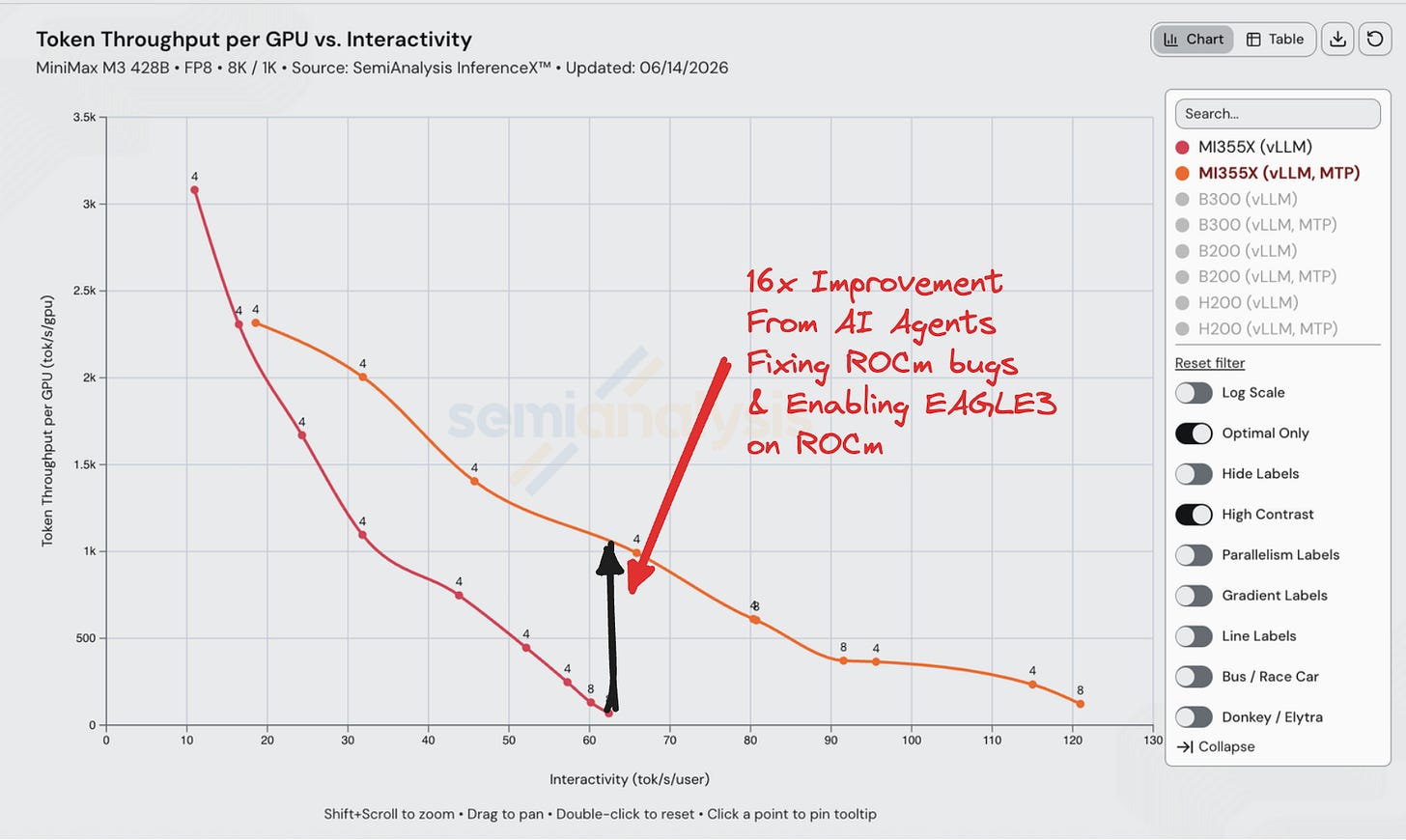
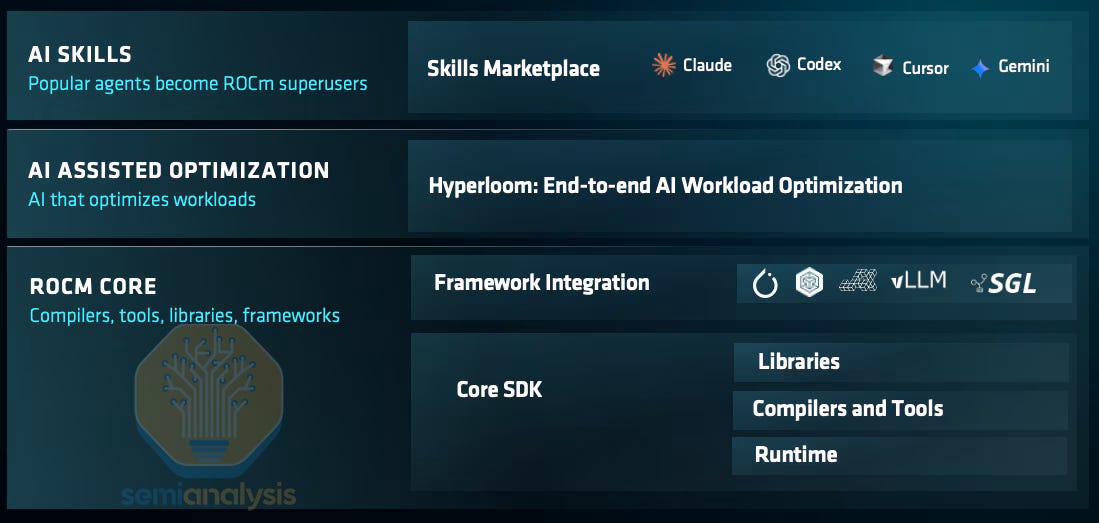
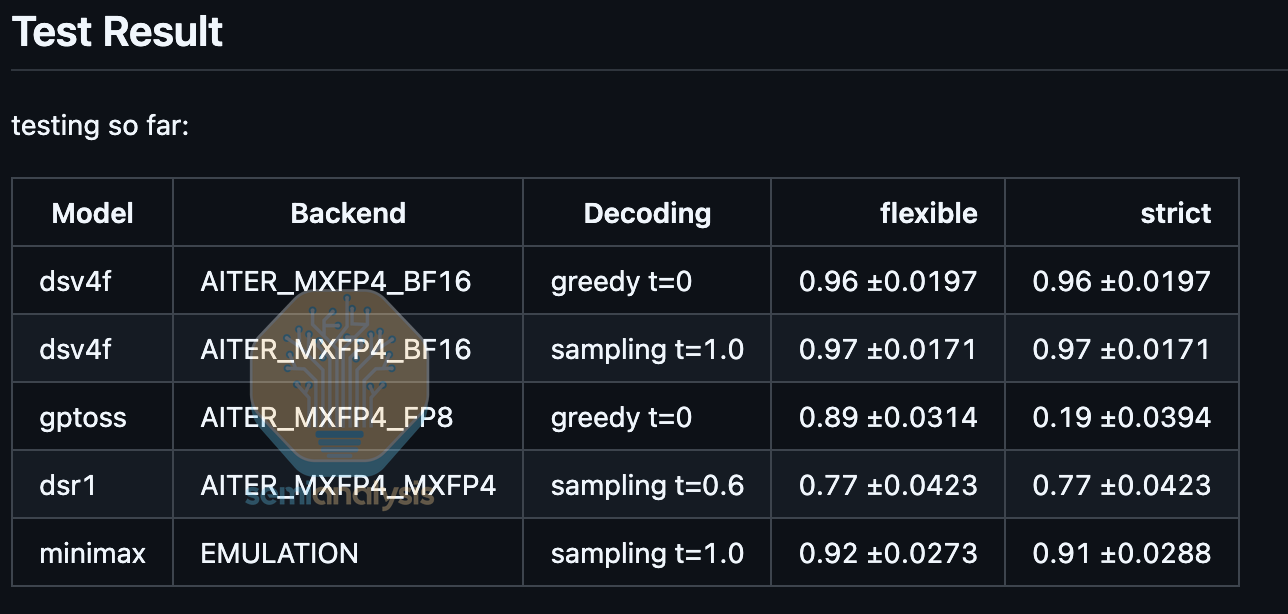
Anthropic 已公开宣布将部署 2GW 的 AMD 芯片,Lisa Su 及其团队正积极拥抱以智能体为导向的工程文化。Anthropic 计算负责人 Tom Brown 举例说明了这一点,他周末使用 Claude 并通过“/goal”指令,在 AMD 硬件上成功启动了内部 Claude 推理栈。我们认为,由于 AMD 的编译器和大部分内核均已开源,他们能更好地迎接智能体时代。不过,下文将探讨的一大风险除外。三个月前,我们的加速器模型指出 Anthropic 将成为 AMD 的客户。一周前,我们也在社交媒体上提及了这一点。
给 Lisa Su、Mark Papermaster、Sharon Zhou、Anush Elangovan 和 Vamsi Boppana 的建议
过去一年在自动化测试方面取得了良好进展,以提升软件质量,但进展速度不够激进。在为自动化测试 CI 和内部软件开发团队提供足够 GPU 集群方面,仍然缺乏紧迫感。总是太少、太迟。
每隔几个月与你们(Vamsi、Anush)会面,偶尔与 Lisa 会面时,我们总是强调 CI 可以做得更好。我们确实能举出 CI 正朝正确方向发展的具体例子,但整体战略需要加速推进。例如,Kubernetes 推理 Pollara NIC CI 与 Nvidia ConnectX Nightly CI 的对等率仍为 0%。Kubernetes 是全球大多数推理部署使用的层。问题不在于 AMD 工程师不想增加支持,而在于内部 CI 容量投资不足阻碍了他们。原计划在 Advancing AI 2026 前实现对等的目标,因集群问题已错过。
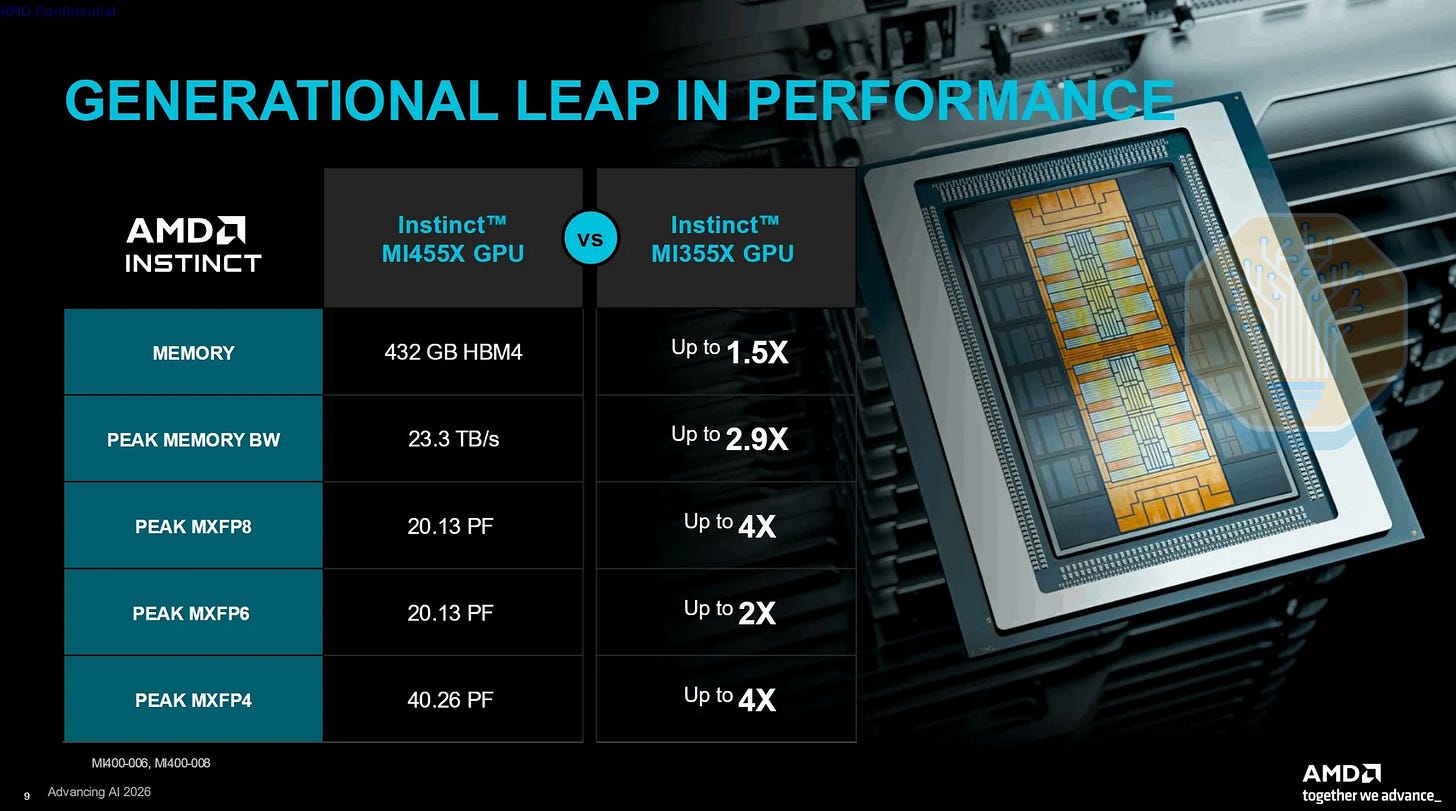
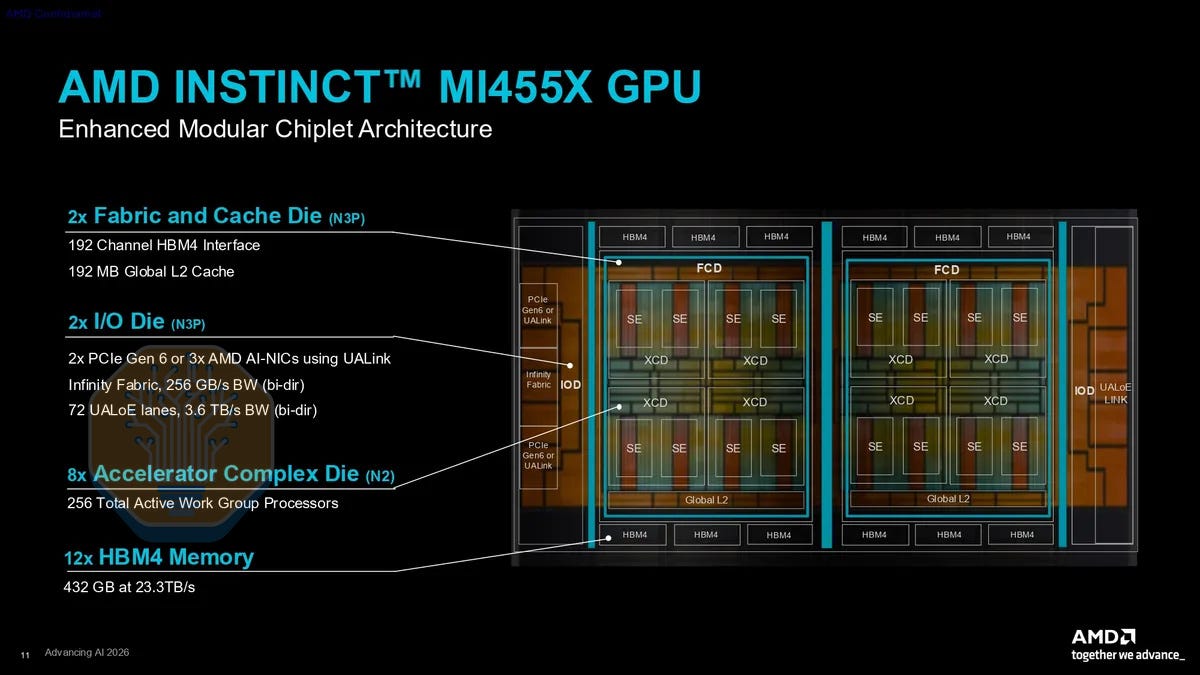
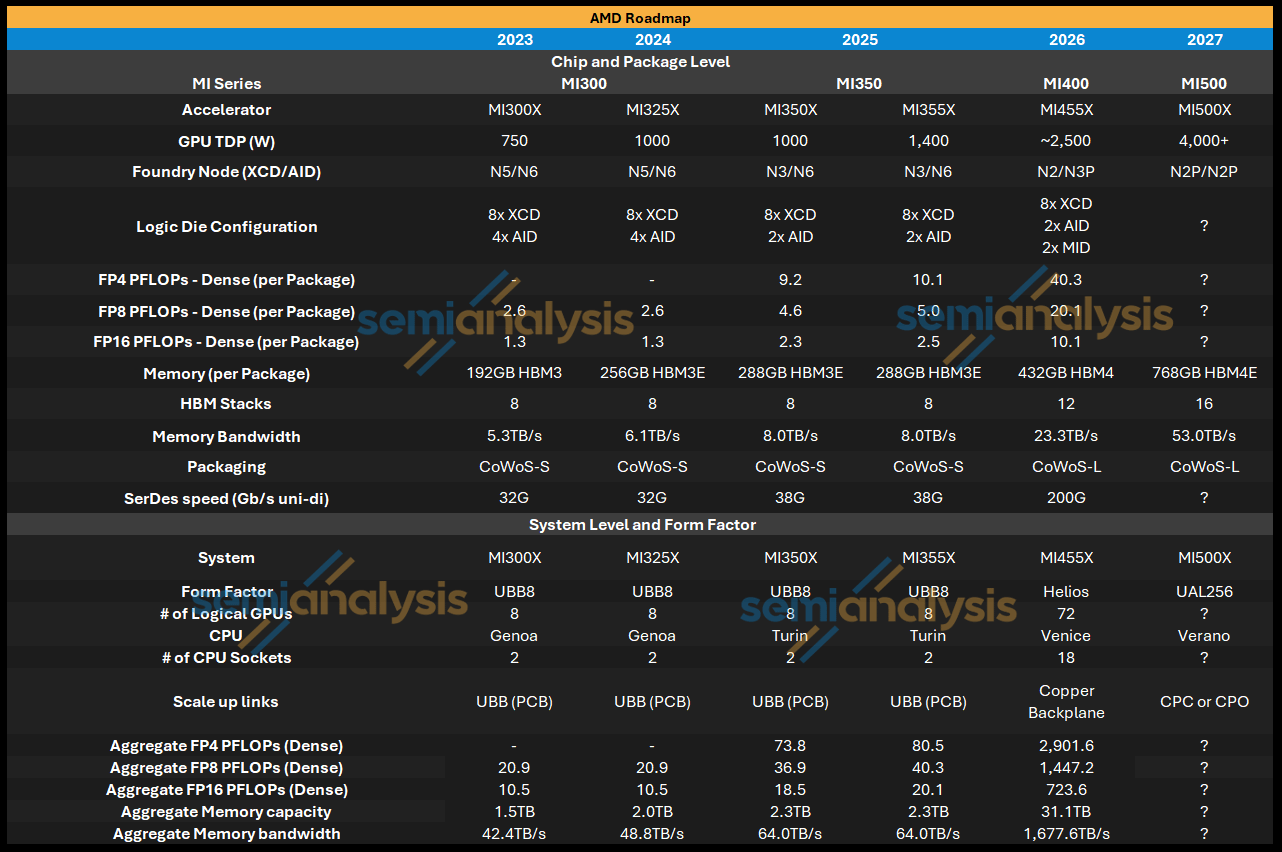
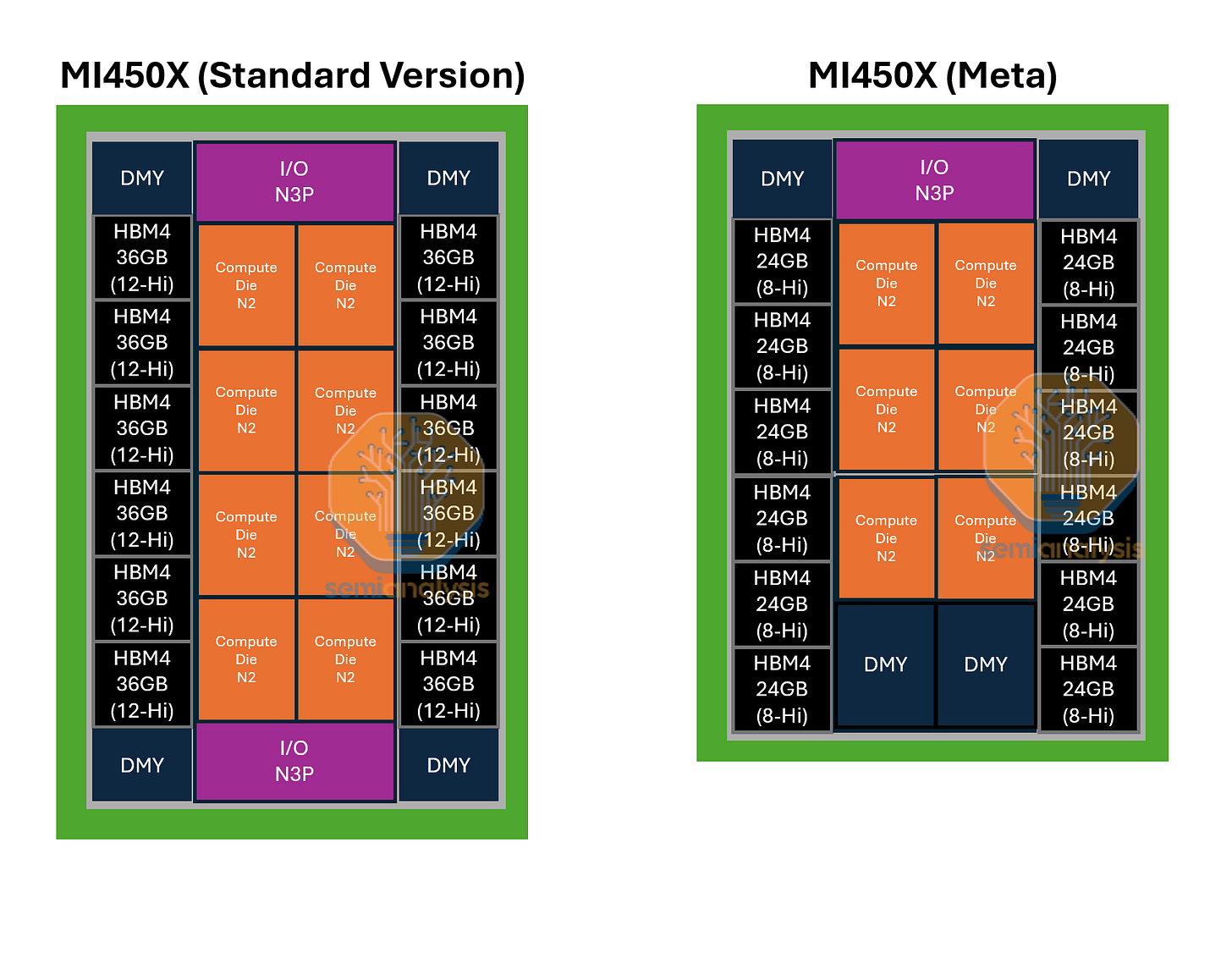
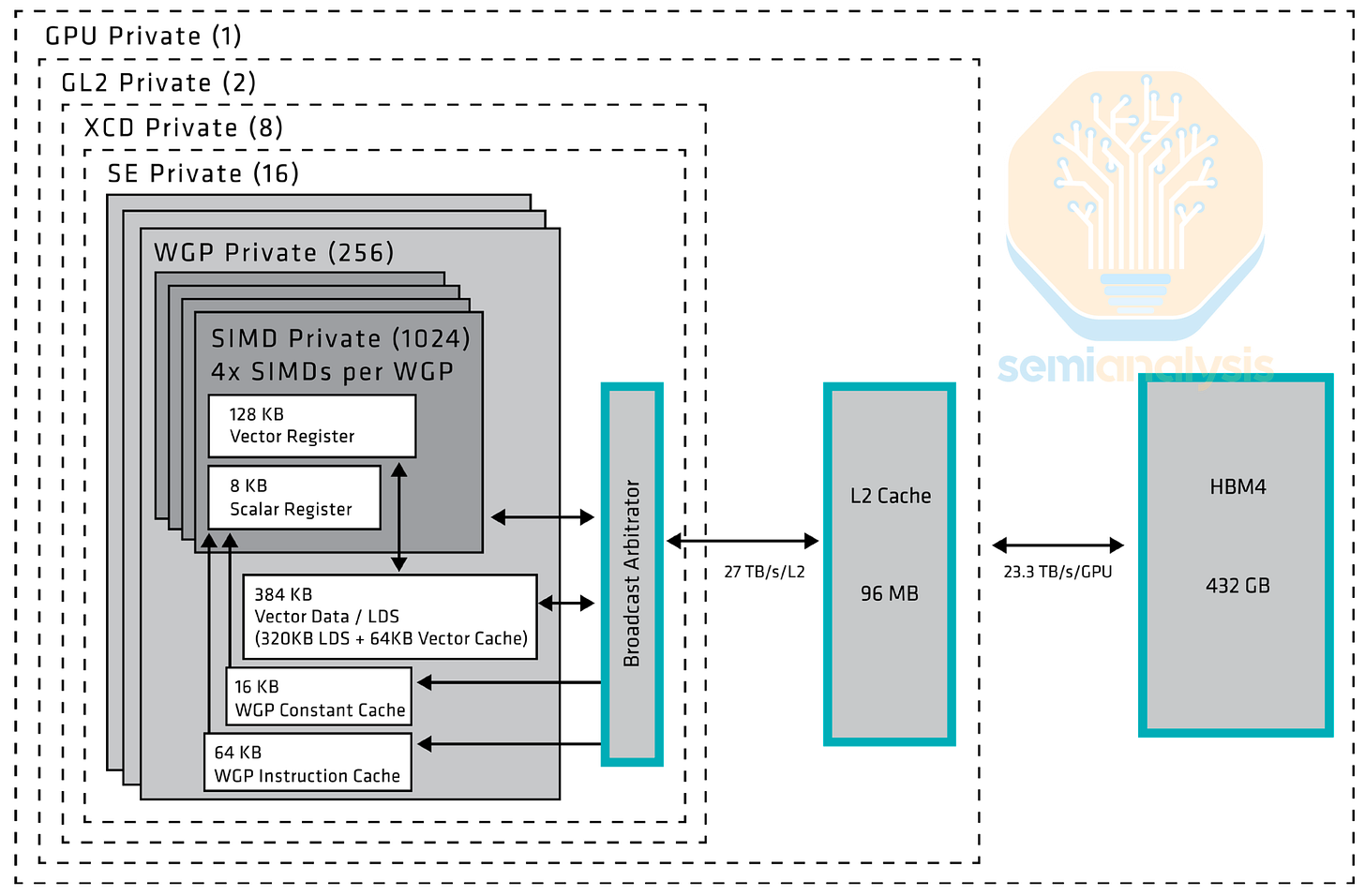
The large package size also allows AMD to fit 12 stacks of HBM4 for a total of 432GB per package. This is again industry leading compared to Nvidia and Google shipping only 8 stacks adding up to 288GB per package. Each base die is now closer to reticle sized with the HBM-facing edge measuring 32mm to squeeze in 3 cubes per edge, compared to the MI300X AID which was 29mm per edge which isn’t enough to fit 3 cubes.
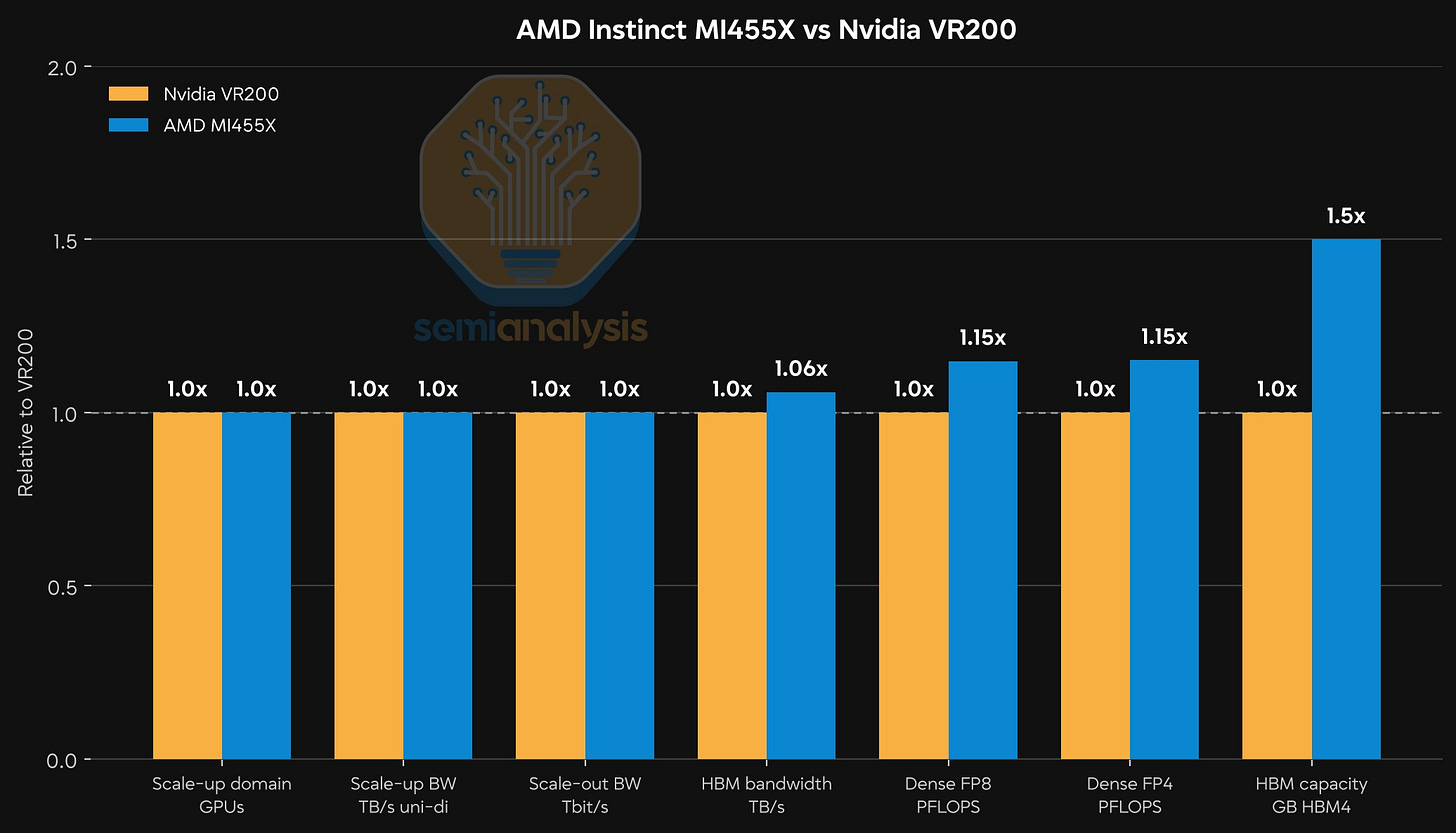
Along with Nvidia with Rubin, AMD is the only company shipping HBM4 this year. Having 12 stacks also allows the MI455 to win on memory bandwidth at 23.3 TB/s per chip, implying HBM4 pin speeds of 7.6Gbps. This is a slight upgrade from the 19.6TB/s advertised at last year’s Advancing AI. Despite having a 50% wider bus than Rubin, the total bandwidth is barely above Rubin at 22TB/s.
This is because Nvidia aggressively raised its targeted HBM4 pin speeds last year to well above the original JEDEC HBM4 specification. This change was precisely driven by the need to make up for the memory bandwidth deficit to AMD MI455X. At Nvidia’s marketed 22TB/s for Rubin, this is a pin speed of 10.7Gbps: 40% faster than MI455’s HBM4 which means NVIDIA will be forced to use an much higher quality bin than AMD.
As we have mentioned before and covered extensively in our newsletter and Accelerator Model , this change was challenging for memory suppliers to keep up with. Memory suppliers had to rework their HBM4 to deliver the spec Nvidia was targeting. This also pushed out upstream output for Rubin but as of today these issues have been finally resolved. This move proved to be a worthwhile gambit for Nvidia as they could close one of the big shortfalls of Rubin and despite the delays, Vera Rubin will still be the first deliver tokens at scale compared to MI455 Helios. More on that later.
Active LSI
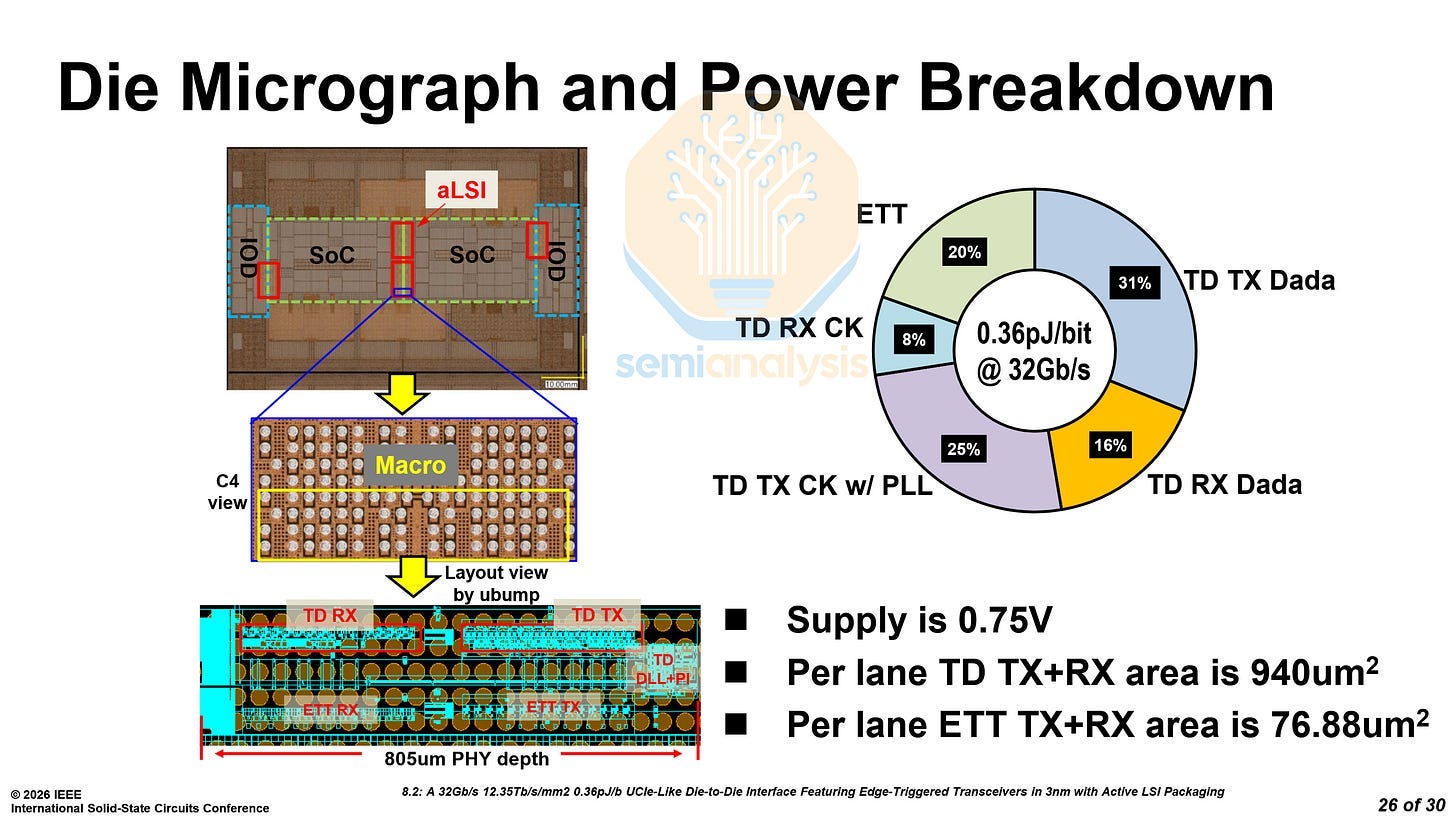
Hidden beneath the surface, we believe that the MI455 is also the known first chip to ship with active Local Silicon Interconnects (“LSI”), which are the bridges that connect the various chiplets within the CoWoS-L assembly. In the brief history of CoWoS-L, the bridges have been passive, containing only wiring as well as capacitors. Active LSIs come with actual circuitry. During TSMC’s aLSI presentation at ISSCC 2026, TSMC demonstrated active bridges with a low-power repeater circuit that regenerates signals mid-channel. The benefit is that because the bridge now shares the burden of maintaining signal integrity, the PHYs on the top dies can shrink meaningfully, at a nearly negligible energy cost, reclaiming leading-edge silicon and shoreline for compute and memory. The give away that this is being shipped in the MI455, and as such it is effectively the “test vehicle”. What TSMC showed is the MI455 interposer: two base dies, 12 HBM4 stacks, and two IO dies.
Source: TSMC Active LSI Die Shot and Power Breakdown, ISSCC 2026
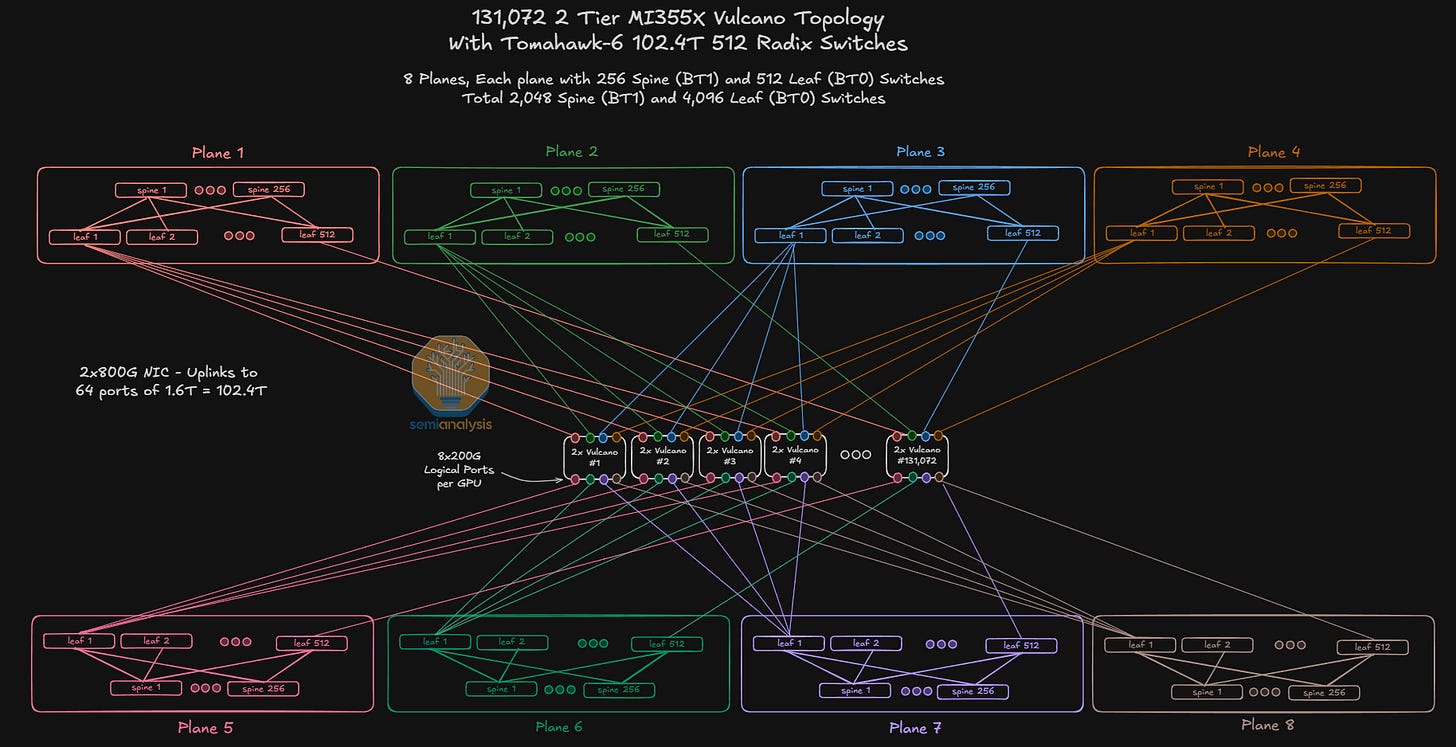
Vulcano 试图解决同样的问题,但它是通过 NIC 来实现的。在这里,NIC 具备三个要素:智能包喷射、路径感知拥塞控制,以及乱序包处理与有序消息交付。这使得能够将网络复杂性从网络架构卸载到 NIC 上。
智能包喷射从根本上解决了低熵问题。在传统的 ECMP 架构中,一个流被哈希到单一路径并保持在该路径上。由于 AI 流量由少数几个庞大的、同步的大象流组成,因此哈希冲突非常频繁,导致某些路径拥塞而其他路径却闲置。AMD 的 AI NIC 不再将流固定在单一路径上,而是将同一流的包喷射到网络架构的可用路径上,将熵水平提升到了逐包级别。其结果是实现了 1:1 的网络架构利用率,并且能够在毫秒内完成故障恢复,因为任何单条链路故障都无法导致整个流中断。
然而,数据包喷洒会带来一系列新问题,这也就是另外两个要素发挥作用的地方。首先,来自不同路径的数据包可能会乱序到达。传统的 RoCEv2 网络会强制数据包执行 go back N 重传,这需要在 NIC 或交换机层面进行缓冲,具体取决于所采用的方案(调度式还是非调度式网络架构)。在这里,NIC 原生处理乱序到达的数据包,并在消息级别强制保证顺序,从而无需缓冲。数据包到达后直接写入 GPU 内存,仅重传丢失的数据包。
其次,盲目地在多条路径上喷洒数据包不仅无法避免拥塞,反而会引发拥塞。Path Aware Congestion Control 弥补了这一缺陷:NIC 会实时跟踪每条路径的状态,并在队列积压之前将流量从拥塞路径转移出去。该机制专门针对 incast 现象,因为像 all-reduce 这样的集合操作通常涉及多个发送方对应单个接收方,会在整个网络架构中引发队头阻塞级联效应。由于决策是在 NIC 层面做出的,且具备逐路径可见性,因此其响应速度足以应对 AI 工作负载的突发性特征。此外,由于数据包是在整个网络架构中进行智能喷洒的,尾部延迟也得到了最小化。
AMD 的 AI NIC 不强制规定传输模型,允许灵活的横向扩展网络。它支持基于交换机的数据包喷洒,适用于网络架构已处理负载均衡的运营商;支持基于 NIC 的数据包喷洒,适用于将智能处理卸载到 NIC 的普通商用网络架构;还支持基于 NIC 的源路由,适用于希望从端点控制路径的运营商。核心在于,网络行为会去适应你已有的网络架构和打算运行的工作负载,而不是反过来。
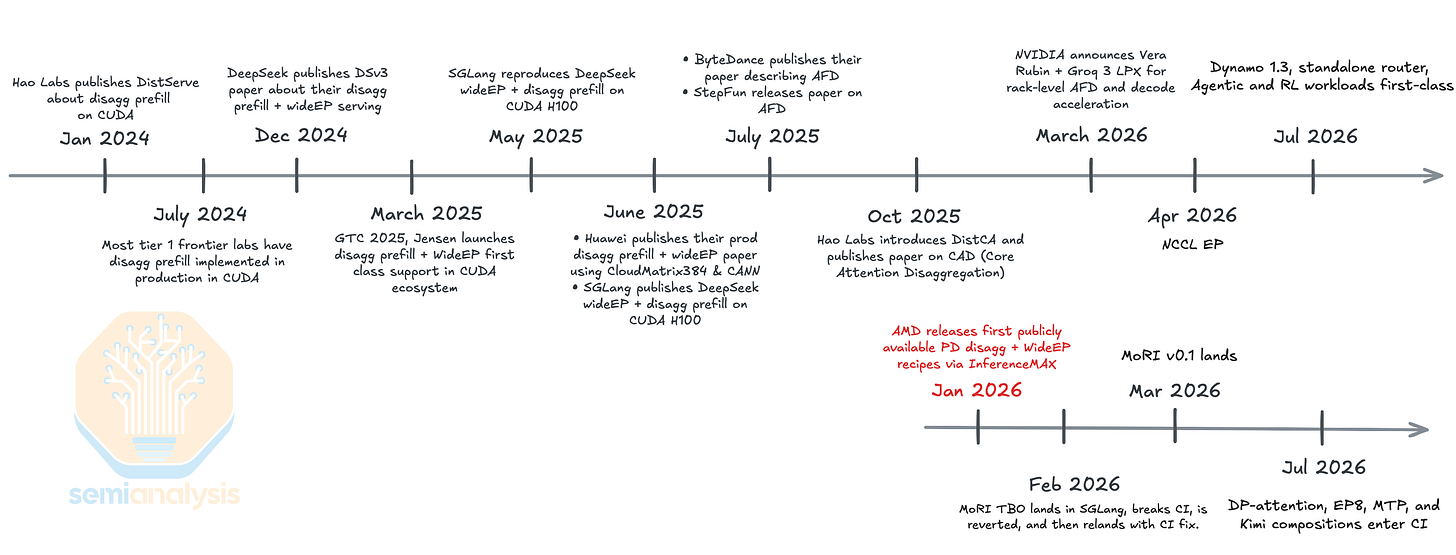
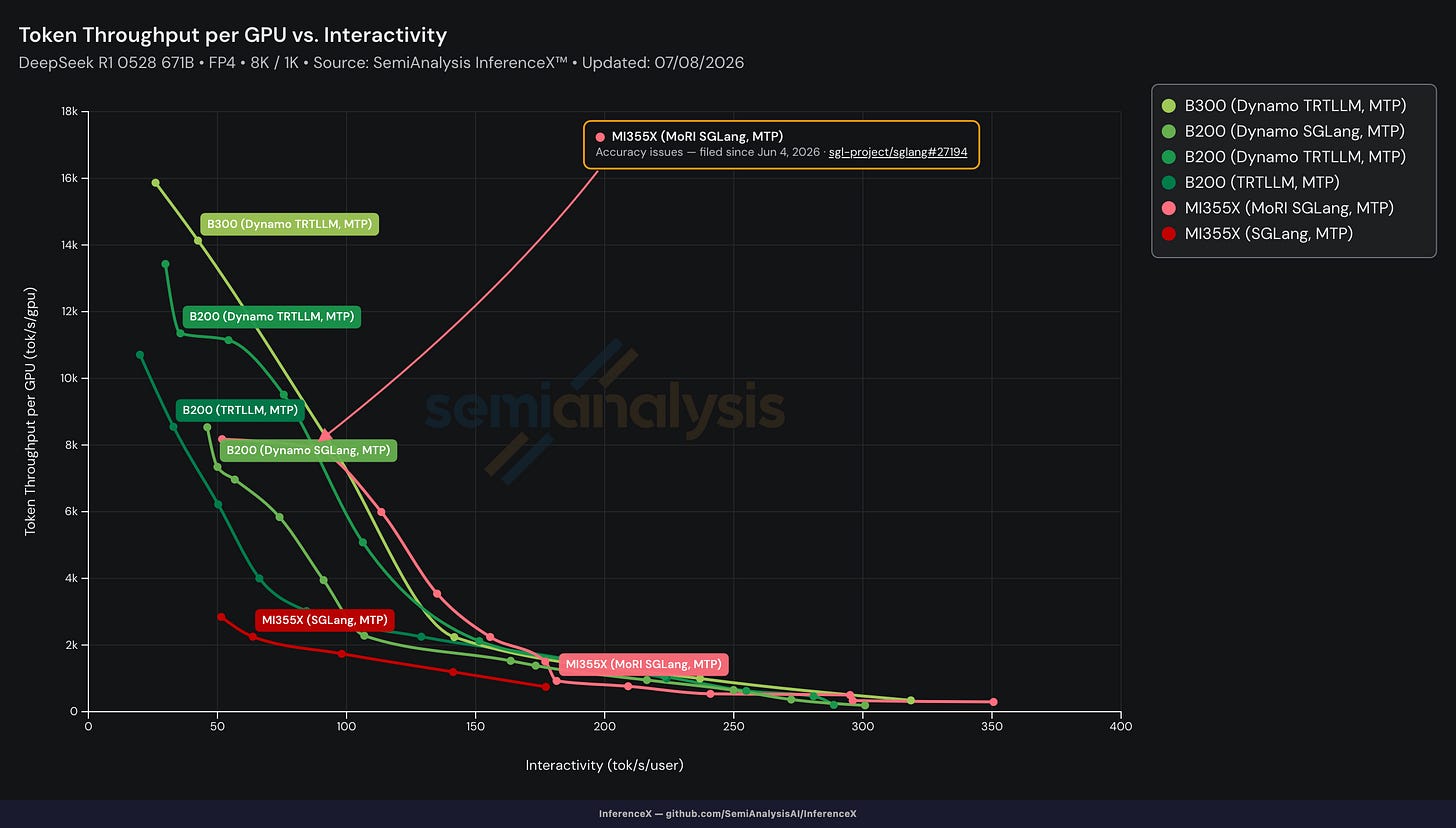
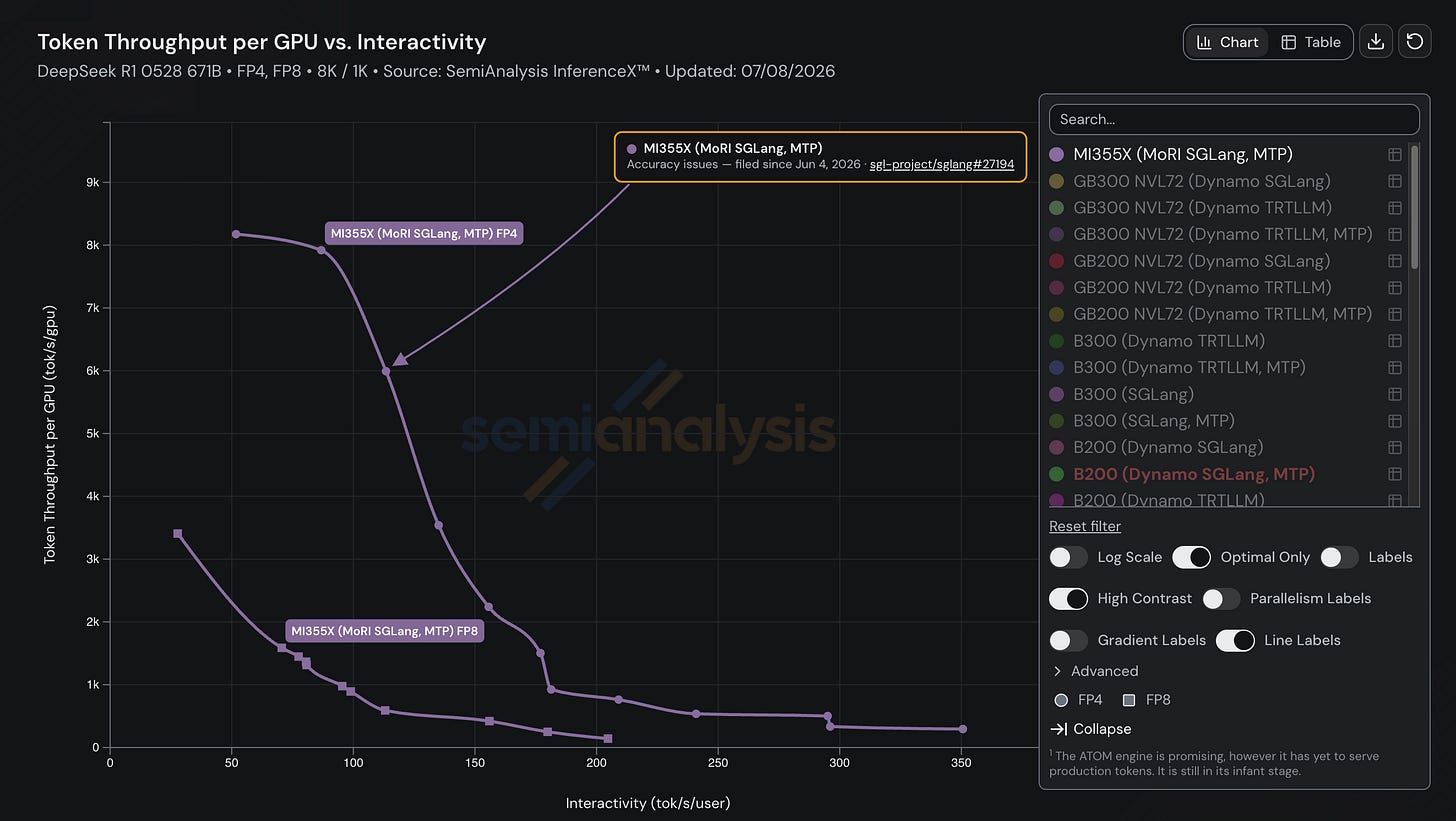
在分离式场景下,AMD 同样表现出色。这与大约 6 个月前相比是巨大的进步,当时团队在 DeepSeek R1 上苦守数月,一直难以达到与 Nvidia 同等的水平。这归功于几个因素。首先,AMD 对其软件栈进行了具体的重大改进,包括用于分布式推理的 MoRI 后端,以及对 Mooncake 的多项改进。更重要的是,由 Hai Xiao 带领的 AMD 分布式推理团队,正以更强的紧迫感开展工作,致力于为分布式推理提供更好的支持。
以下视频显示,MI355X FP4 分离式解决方案曾落后于 Nvidia 的方案数月之久。
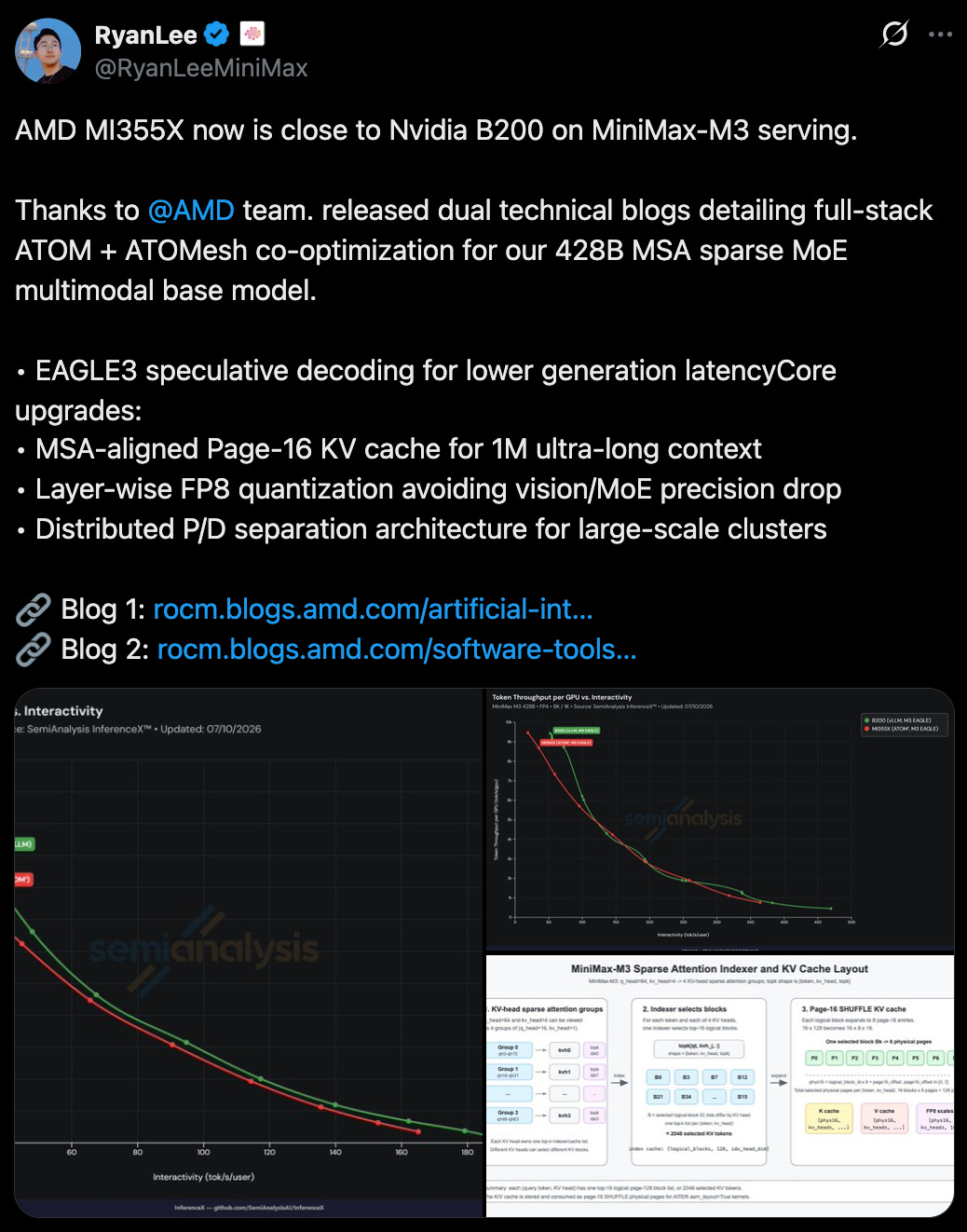
Note that this was AMD’s first public disagg recipe, posted on InferenceX in January. Take this in stark contrast with the Day 0 progress on MiniMax M3 FP4 disagg shown below, and you can see AMD is in a much better position now to be competitive in terms of distributed inference solutions.
Source: SemiAnalysis InferenceX
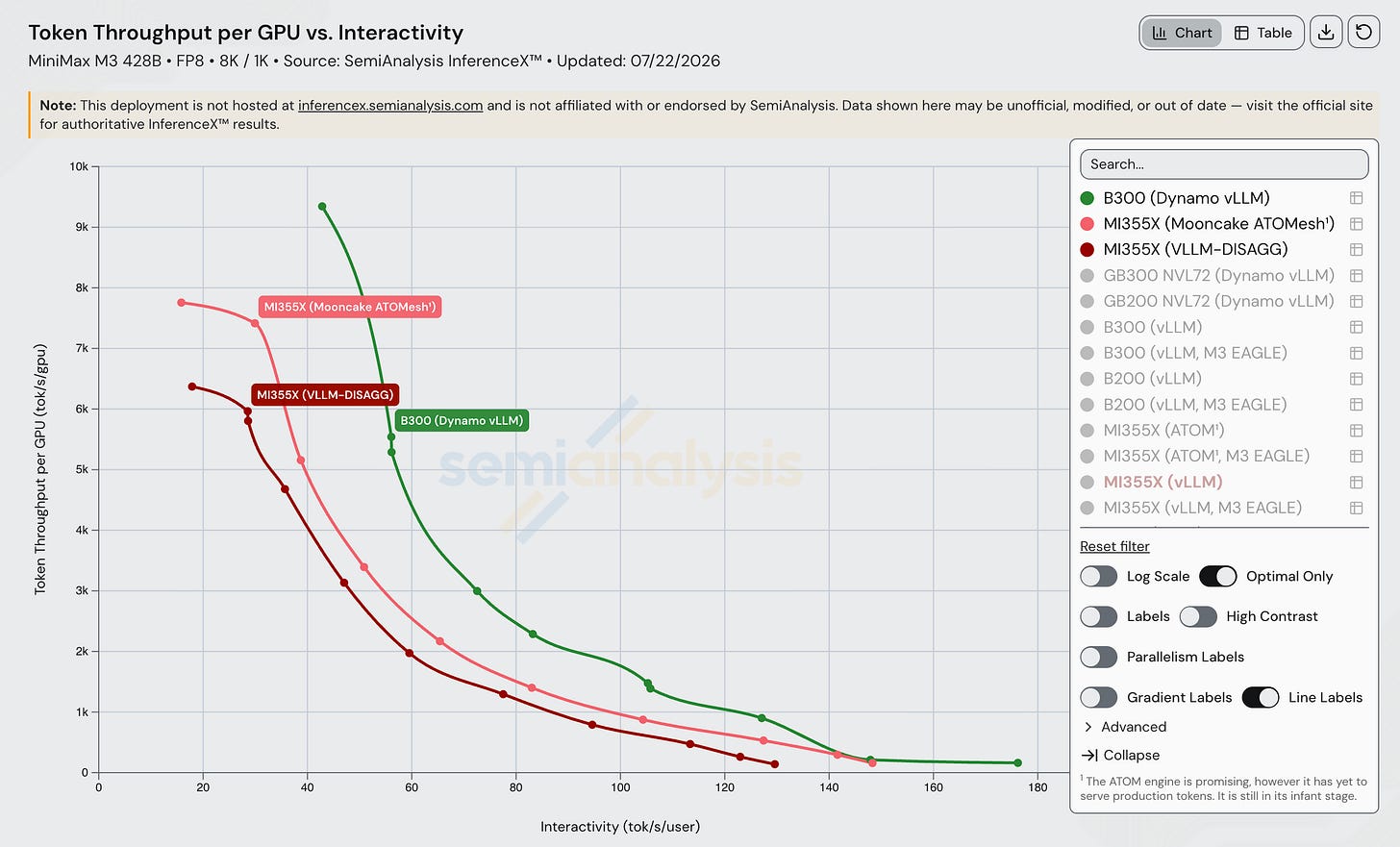
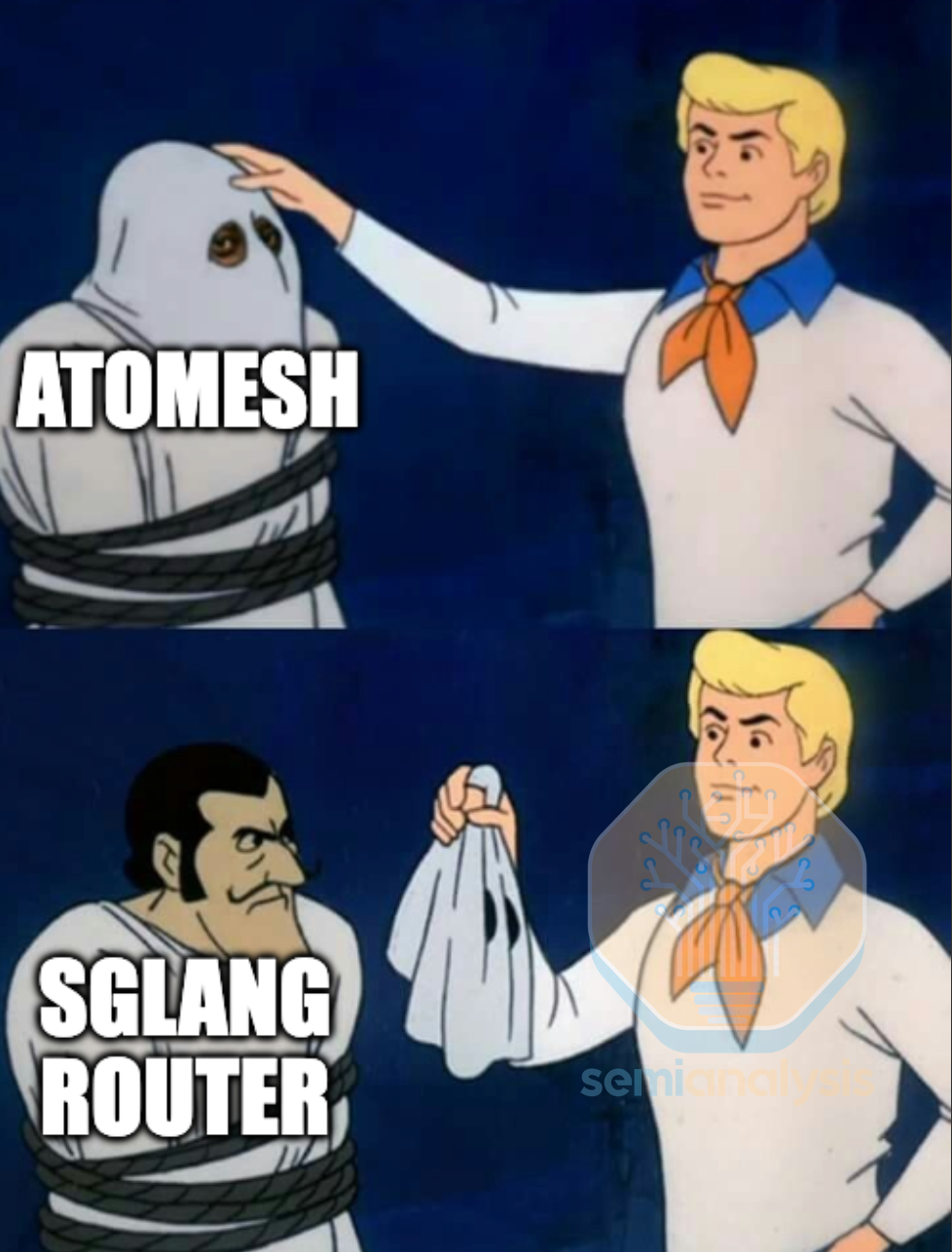
However, going fast isn’t easy. Especially when the competition has a head start. The missing one piece is now real: what AMD’s distributed stack was missing above is now addressed by the engine that comes with ATOMesh . It is a ROCm-native distributed-inference gateway featuring a Rust routing and orchestration layer that handles the cluster-level work disaggregated serving needs, such as prefill/decode-disaggregated routing, cache-aware load balancing, RDMA KV-cache transfer (via MoRI-IO or Mooncake).
It is not a from-scratch build: ATOMesh is derived from SGLang’s sgl-model-gateway , and is substantially reworked around ATOM and AMD hardware. However, it works, as shown in the MiniMax M3 InferenceX results above. Routing policy stays separate from model execution, and it plugs into vLLM and SGLang as naturally as AMD’s own ATOM engine.
Source: SemiAnalysis
Chipping Away at the CUDA Moat: Using Agents to Enable Day 0 Support
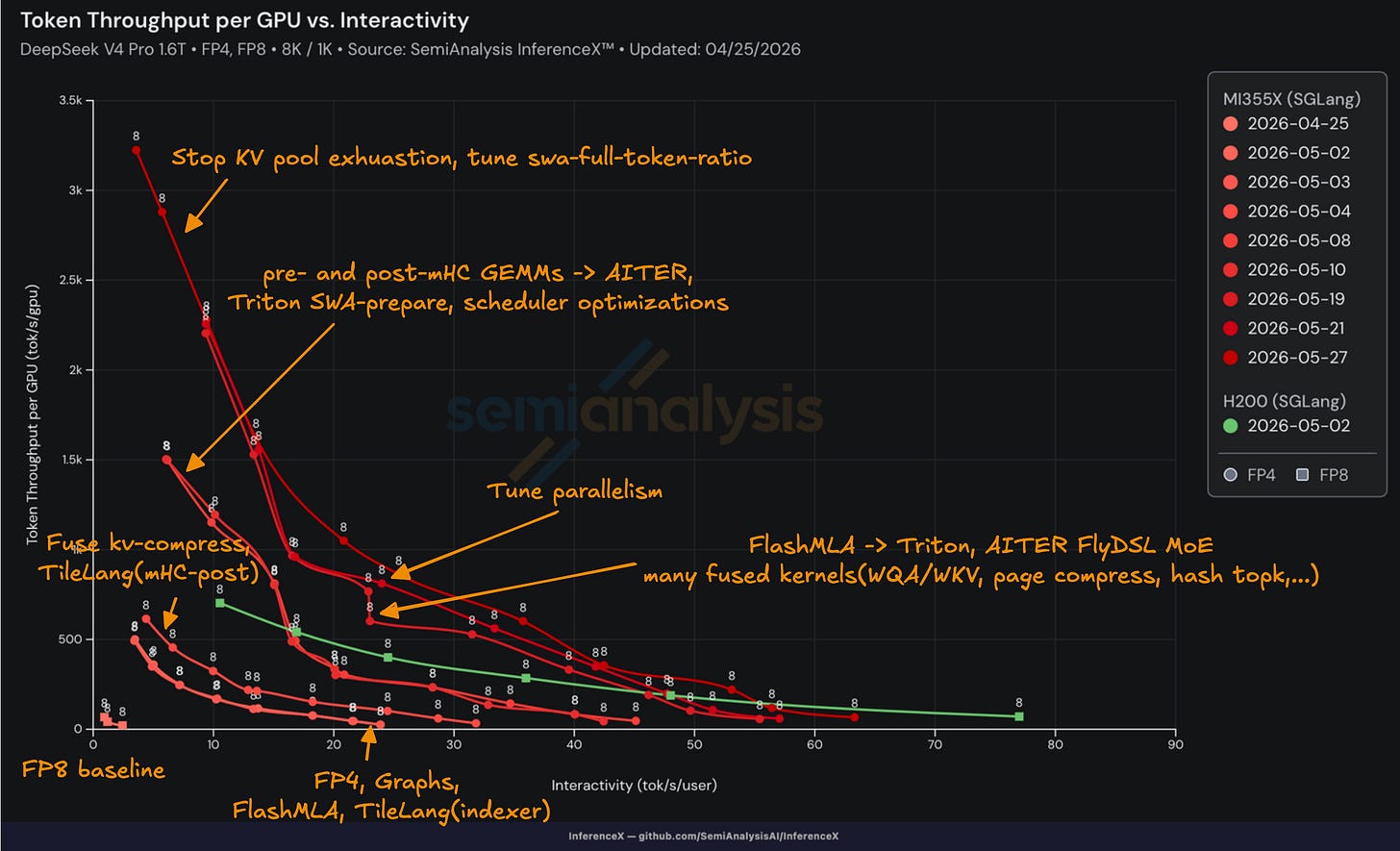
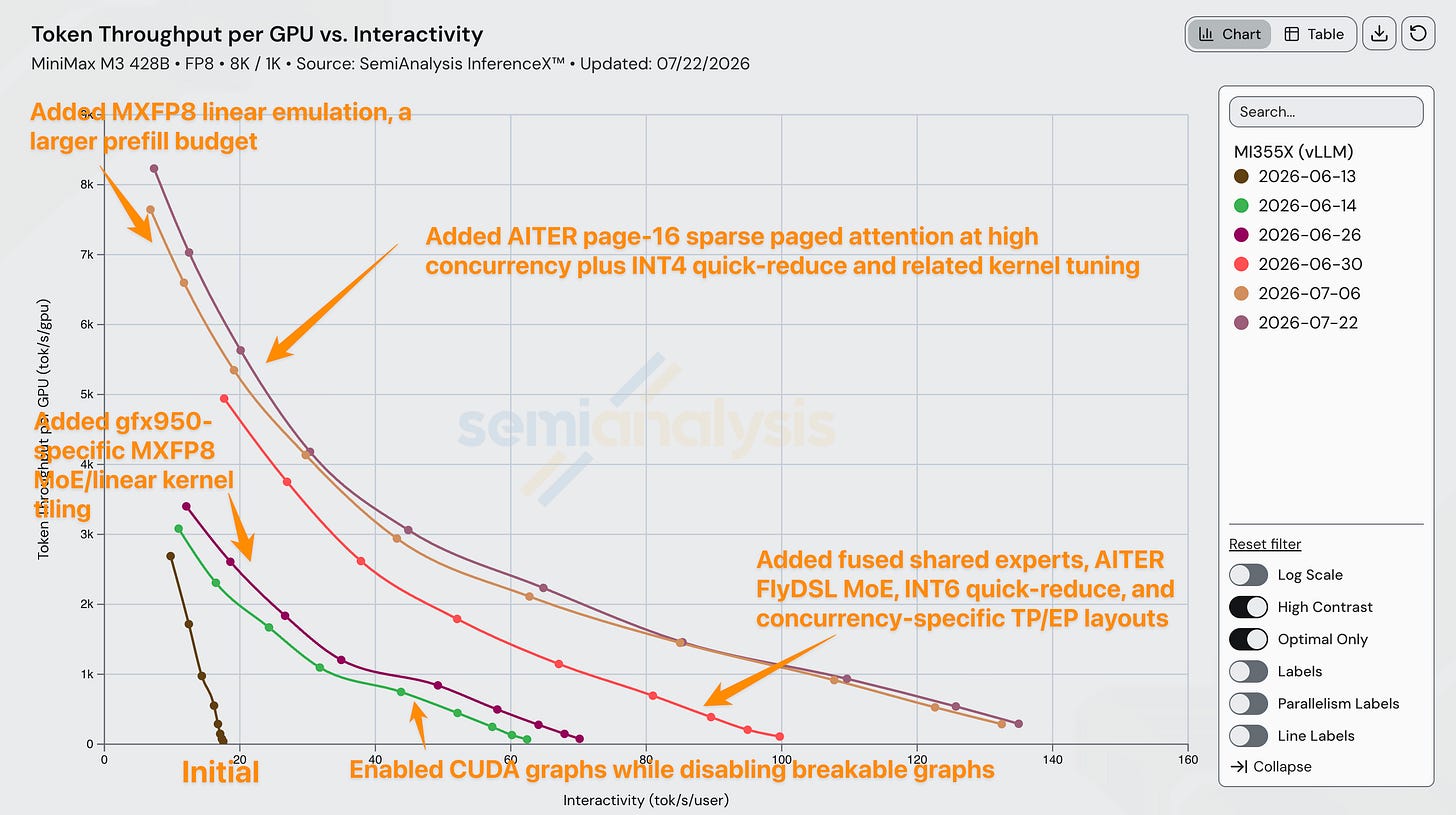
The SemiAnalysis team grinded to enable day 0 support for DeepSeek v4 and MiniMax M3, and we will continue to do so for upcoming frontier models such as Kimi K3. This “day 0” perf is an important baseline for showcasing performance over time , which is the north star goal of InferenceX.
Obviously, the 100x cracked engineers at AMD, Nvidia, Inferact, RadixArk, etc are responsible for the hardcore inference engineering work to truly enable day 0 support for these models. However, often times there are bugs to fix or low hanging fruit that the SemiAnalysis team adds in order to enable day 0 sweeps (currently, these are more prevalent with AMD configs). This has become increasingly easy with the rise of capable agents. The flow looks something like this: for a given config (I.e., MiniMax M3 vLLM MI355X FP8), start a new Claude Code/Codex agent to pull the day 0 recipe from the internet, create the necessary plumbing in InferenceX, and then kick off the sweeps. The agent has access to both the GitHub Action as well as direct access to the physical runner to continuously monitor the status. In the case of an engine error, the agent can automatically decipher what the root cause is, and either iterate automatically and re-run or consult the human for intervention. We can execute this pipeline in parallel for multiple configs on various SKUs.
When an error is identified, the current models are quite good at identifying the cause in the upstream engine code (vLLM/SGLang/TRT) and few-shot implementing a fix, with some guidance from the team. Additionally, we use agents to identify low-hanging fruit performance improvements. Some examples of upstream contributions by the SemiAnalysis team + agents:
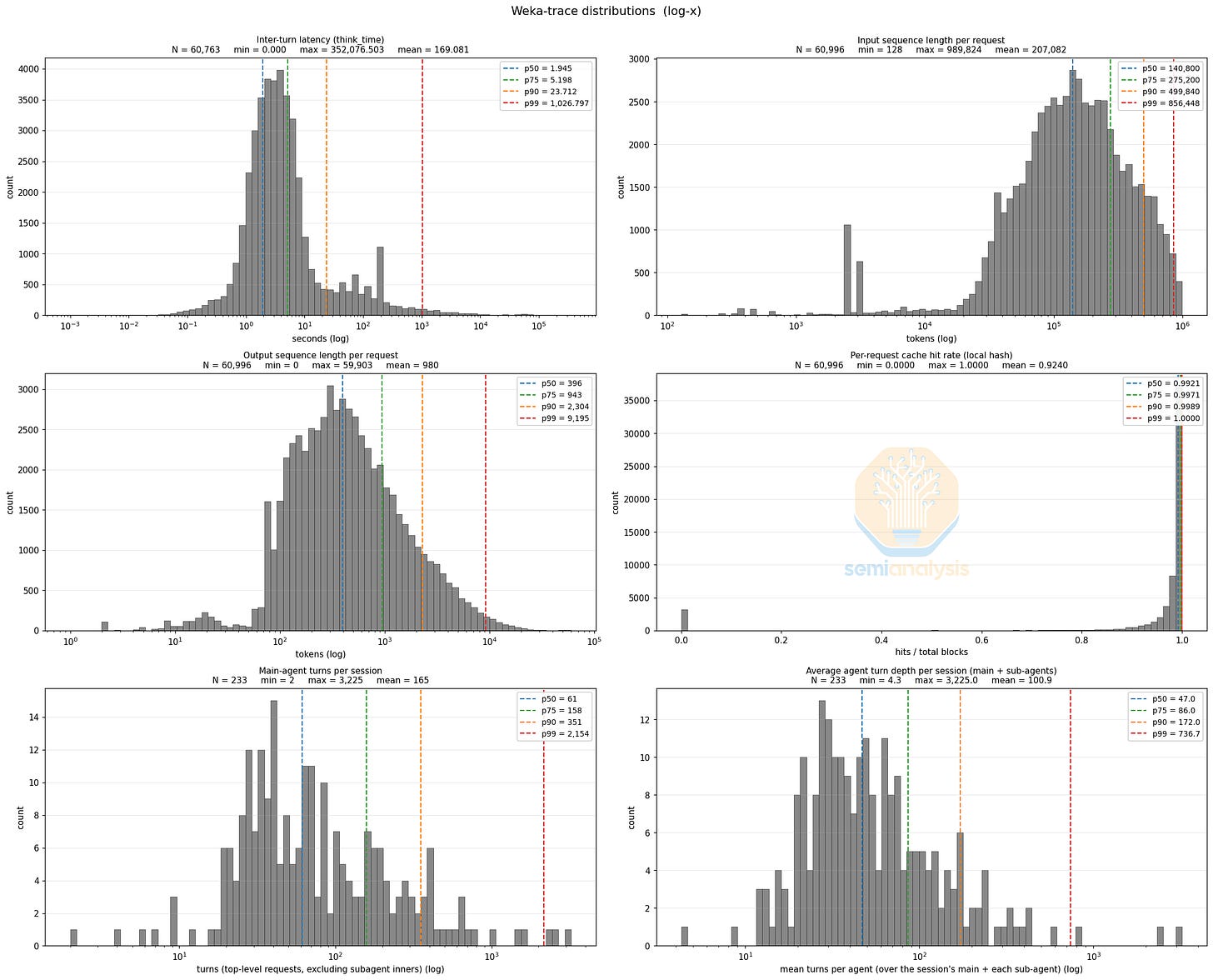
For the past few months, we have been working with industry leaders to develop an agentic benchmark: AgentX. To achieve our goal of making the benchmark as reflective as possible of real world serving, we collected ~3 months of internal SemiAnalysis Claude Code, Codex, etc. traces, which we then replay offline at varying concurrencies using AIPerf. Some of the statistics of the dataset are shown below. Notably, the median ISL and OSL are 140k and 396, respectively (quite different from 8k1k). With a median cache hit rate of 99.2%! Note, this is assuming an infinite cache so is not, of course, actually attainable in most real-world serving.
The dataset also includes realistic subagent usage as well as dynamic workflows, which further stresses the KV cache by continuously introducing uncached context for the server to process. The tool use time / user think time (captured by inter-turn latency) is also reflected in the dataset, further stressing the KV cache and highlighting the efficacy of KV offloading techniques, which have the possibility of increasing KV cache TTL.
Source: SemiAnalysis HuggingFace
We are very excited about this scenario. We have worked with WEKA, Inferact, RadixArk, LMCache, Mooncake, NVIDIA, AMD, and other industry leaders in ensuring it accurately reflects real traffic that may be experienced by a TaaS provider or frontier lab like OAI/Ant.
Results have been rolling in for the past month and are available on InferenceX. We will write an in-depth article on results and methodology soon.
Single-Node is Out, Disaggregated is In
As discussed, the competitive frontier has moved from single node aggregated to multi node disaggregated inference. In our InferenceX v2 article, we discussed the notion of AMD’s “software composability problem” when it came to distributed inference. That is, they had made strides in individual optimizations such as disagg, FP4, WideEP, DP-attention, etc, but combining many of these together broke the stack. While there is still certainly progress to be made, AMD has made significant strides in this area.
Our GTC 2026 recap frames Nvidia’s next moat as disaggregated inference systems, including attention/feed-forward disaggregation (AFD). Since attention is stateful and KV-bound, while FFN is stateless and batch-scalable, these phases can be split and mapped onto the best-suited hardware. Then, inference leadership becomes a distributed-systems problem rather than a single-kernel one. WideEP, disaggregated prefill, KV transport, expert routing, and scheduler/orchestration are all part of that same new moat. AMD can close single-node gaps, but unless those optimizations compose cleanly in vLLM and SGLang, it is still fighting yesterday’s war.
Even AMD’s own engine follows the pattern. ATOM’s Helios work is disaggregation-first and expert-parallel-later: ATOM adds DeepSeek-V4 MoRI-IO write-push KV transfer plus a UALink scale-up fabric backend — the Helios-generation interconnect — so the KV-transport half of disaggregation is being built for exactly the model and fabric Helios will run, though its e2e validation ran on eight MI355X nodes and a UALink vPOD rather than MI455x. But it carries no EP dispatch/combine, no MoRI-EP, no WideEP; ATOM’s shipped DeepSeek-V4 recipe still serves the model at TP=8 on a single node, and every one of its MoRI-EP PRs targets last-generation gfx942/gfx950. Bottom to top:
PyTorch, kernels, MoRI, frameworks, ATOM, Helios has arch enablement and the first half of disaggregation, and no WideEP anywhere.
SemiAnalysis Helping AMD upstream into NVIDIA’s KVCache Transfer Library NIXL
At Nvidia’s GTC 2025 NCCL session , we asked if Nvidia would provide support to the AMD communication library fork due to this big refactor in the upcoming Nvidia’s communication library. Nvidia explicitly said it would not help AMD’s communication team adapt to the upcoming NVIDIA library refactor, and that NVIDIA doesn’t participate in AMD’s communication development at all
A year later, at Nvidia’s GTC 2026 Dynamo session, we asked a question: NIXL had already accepted upstream contributions from Trainium’s Neuron fork, so would it accept them from AMD’s RIXL fork too? The maintainers said yes, on the record, in front of a room.
AMD had been carrying RIXL downstream, burning engineering hours maintaining a parallel copy of infrastructure everyone else gets for free. The only thing standing between AMD and upstream was whether anyone would try. NVIDIA had just removed the excuse.
So we spent April making sure AMD knew it. We put the question to Stephen Bates publicly on LinkedIn , offered Anush help to connect AMD directly to the NIXL maintainers , and asked Anush about MoRI/RIXL upstreaming in person during TensorWave’s beyond summit and we helped AMD form the relationship with NVIDIA so that they can upstream the patches.
On May 15, AMD’s Andy Luo opened a PR for ROCm/HIP build support for gfx942 (MI300X, MI325X) and gfx950 (MI350X, MI355X), behind a default-off use_rocm Meson flag. It merged June 4 after several rounds of review with NVIDIA-side maintainers.
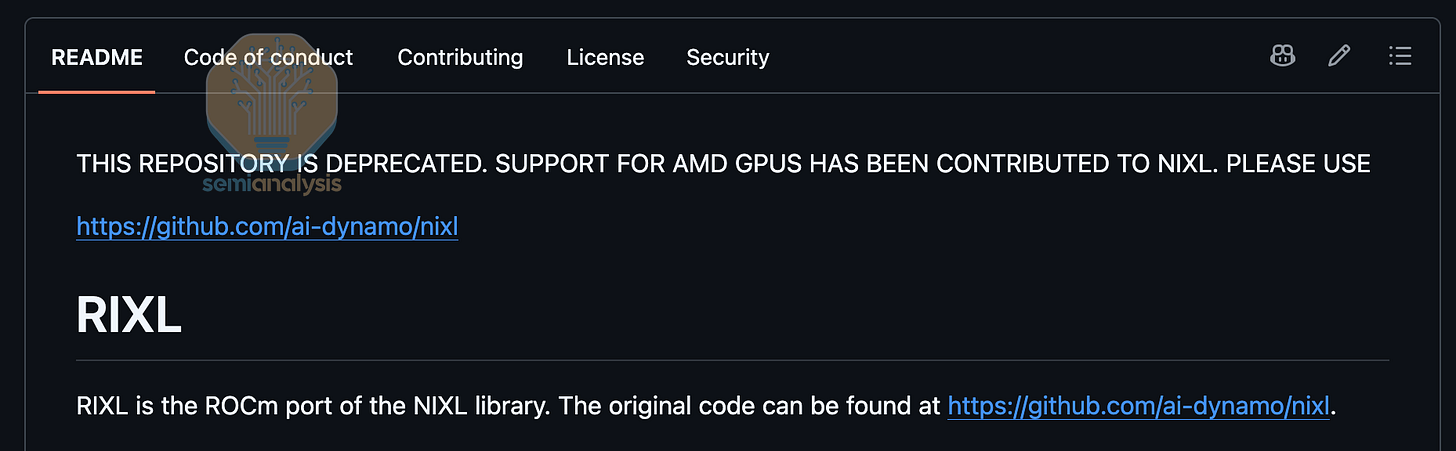
Andy’s PR cleared review by proving zero blast radius on the CUDA path. On the AMD side it validated end-to-end VRAM transfers over NIXL+UCX on MI300X and MI355X. The stacked follow-up, #1647, hit 341 Gb/s cross-node RDMA on two MI355X nodes using AMD’s own AINIC RoCE NICs and libionic driver, with no Mellanox NIC in the path. Today, RIXL has been fully ported to NIXL. Dynamo core has since started taking AMD patches too .
Source: https://github.com/ROCm/RIXL
NIXL 是解耦服务架构的传输层。如果 AMD 希望 PD 解耦和 WideEP 能真正稳定可靠,而不是仅限于特定模型,那么 KV 传输就必须能在用户实际部署的框架中运行于 Instinct 之上,而不仅仅是在 MoRI 内部。AMD 内部本不该由我们来指出这一点。目前遗留的短板也反映了同一问题:nixlbench 的 HIP 支持与 ROCm Dockerfile/CI 环境是作为后续独立任务提交的;AMD GPU CI 运行器目前仍只是个提议,尚未成为合并的工作流;而 rocSHMEM 还只是一个未来计划中的插件。